Case Study · Enterprise SaaS
Reimagined Zoning Compliance Reporting
Context
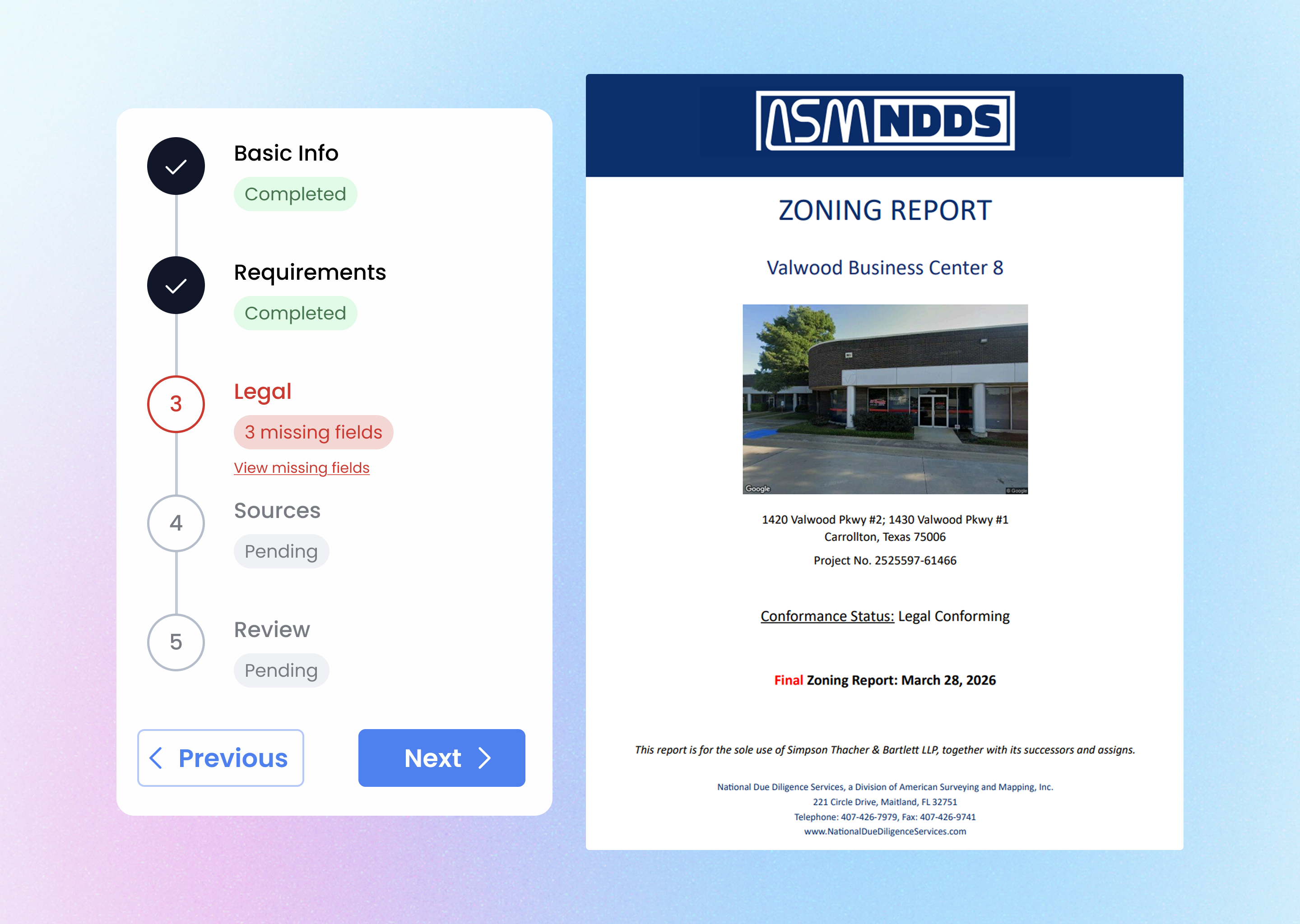
From error-prone Word templates to an intelligent SaaS
When report writers spend 20–30 minutes per report fixing repetitive data-entry errors, that's not just a workflow problem — it's thousands of lost hours annually. As the sole designer-developer at a real estate due diligence firm, I transformed our zoning compliance process from error-prone 20+ page Word templates into an intelligent SaaS solution that achieved 100% adoption.
The Problem
Problems we are solving for
.svg)
Manual Overhead
The workflow required extensive data entry across 12 standardized sections, often involving repetitive input for nearly 100 fields.
.svg)
Time Waste
Report writers wasted 20–30 minutes per report managing human errors and fixing repetitive data entry.
.svg)
Lack of Standardization
Inconsistent terminology and unit measurements (e.g., "15 feet," "15 ft") added unnecessary complexity and reduced overall report quality.
The Solution
Solutions
Strategic Alignment
I reframed the tool as a "TurboTax for zoning reports" to resonate with stakeholders, emphasizing the value of a guided, error-resistant workflow.
Standardization
Automated units of measurement and implemented complex conditional statements to guide users through diverse report scenarios and maintain standardization.
Reliable Formatting
Created complex Word and PDF template files to ensure consistency in spacing, layout, and typography across many scenarios and types of reports.
Automation
Built Node.js cloud functions that query their legacy SQL database to draft the majority of a report, so users no longer type out roughly 30% of the data.
Dynamic Logic
Leveraging Vue 3 reactive components, the form adjusted inputs dynamically based on prior answers, significantly streamlining the user journey and reducing cognitive load.
Project Management
Made the iterative zoning reporting process across a property's phases easier to manage and edit as new data comes in, streamlining the reporting life cycle.
Process
How I built it
As the sole designer and developer, I executed a lean methodology focused on rapid iteration.
Lean Discovery
Due to limited access, I reverse-engineered requirements by auditing over 50 historical reports and collaborated daily with the Head of Zoning to tailor the solution.
Prototyping
I used a tiered-fidelity approach (Lo-Fi Figma → Hi-Fi ProtoPie) to map form logic and secured stakeholder alignment by providing working prototypes rather than static mockups.
Agile Iteration
With little user access before building, I knew the real answers would come from post-launch feedback — so my focus was shipping a working MVP as quickly as possible, then iterating.
Results
What it delivered
Closing Statement
Beyond the metrics, this project sparked a cultural shift toward digital-first approaches in a traditionally paper-based department and industry, paving the way for future innovations.